The Attitude of Ancient the Egyptians to Sex

Herodotus, the Greek historian and traveller to Egypt in the 5th century BC, was the first foreigner to try to bridge this gap in understanding by telling the world about the Egyptians of his time and. insofar as possible, of their ancestors. He collected extensive information about this strange people. He was concerned with almost any kind of information and he passed on whatever he heard, leaving it to the reader to believe it or not. We are still wondering how much of it was actually true.


Among the more intimate details concerning the Egyptians he obtained the following piece of information, apparently a mixture of what he had himself observed and what he had been told.
The women urinate in a standing position, whereas the men sit down. They relieve themselves indoors and eat in the street, and they give as reason for this the fact that things unseemly should be performed in private, but things not unseemly should be done in the open. The Egyptians and those who have learnt it from them are the only ones to perform circumcision. Every man has two garments, every woman just one. They are particularly careful always to wear clean linen. They circumcise for reasons of cleanliness more than secmlincss. Their priests shave their bodies every second day, so that no lice nor any other pollution should contaminate them in the service of the god.... They wash with cold water twice during the day and twice during the night.


On this occasion Herodotus had nothing more to say about anything remotely connected with sexual matters (but he refers to them later, cf. below). One may perhaps take it however, that erotic activities were among those which took place indoors (or he would have noticed and not omitted commenting on it) and therefore considered by the Egyptians to be, if not ‘unseemly’, at least fairly private.



The sex of the Pharaohs


Sex is a basic human need, common to all people at all times. It is evident that the ancient Egyptians were real human beings, not only a people who built massive pyramids and made mummies of their dead. The ancient Egyptians had a rich and varied sexual life, which they found an opportunity to describe in words and pictures.

 As in the other early primitive civilizations, erotic matters were of prime importance and became an integral part of life. In Pharaonic times, the Egyptians described impotence and recorded several methods to increase the sexual power.


 In the present paper, we will shed light on some aspects of the sexual life in ancient Egypt that may be interesting to the urologists, including ancient Egyptian concepts of sex and erotic matters, their own way of treatment of impotence and Min, the Egyptian fertility God.


We will talk about sex with the Pharaohs, in successive articles 


Sometimes given as either the son or consort of Isis. He was depicted in human form with an erect penis. He generally held a flail in his raised right hand and wore a crown surmounted by two tall plumes. Min was pre-eminently a god of male sexuality, and in the New Kingdom (1567–1085 BC) he was honored in the coronation rites of the pharaohs to ensure their sexual vigor and the production of a male heir. The ‘White Bull’ appears to have been sacred to him, as was a type of lettuce that bore a resemblance to an erect penis and had a white sap that resembled semen .


After some preparation, some purification, the magic words were spoken, some rites were performed, and all was over. In many cases this was probably enough for the patient who was under great nervous tension to feel suddenly improved or even cured. Siegerist8 added that ‘we all have seen miracle cures since there is still a great deal of magic religious medicine in our present Western World and our knowledge of psychiatry makes it possible for us to understand the psychological processes involved much better than in the past’. It may be astonishing that at present time some cases of psychogenic impotence are improved by the ‘secret acts’ of these laymen physicians, still found in Egypt, in spite of the failure of treatment by professors of modern westernized psychiatry!.Amusingly enough that the Egyptians still use the term ‘secret diseases’ instead of ‘venereal diseases’.

Siegerist described the way in which the laymen physicians in ancient Egypt used magical spells to affect the sexual power of their clients.

 A disease of the male genital organ caused by an enemy, man or spirit, was to be thrown back to its author by having a mythological incantation made of cake, inscribed with the name of the enemy, his father's name and his mother's name. To be put in the midst of fat meat, to be given to the cat. The magician came or the patient was brought to him. 


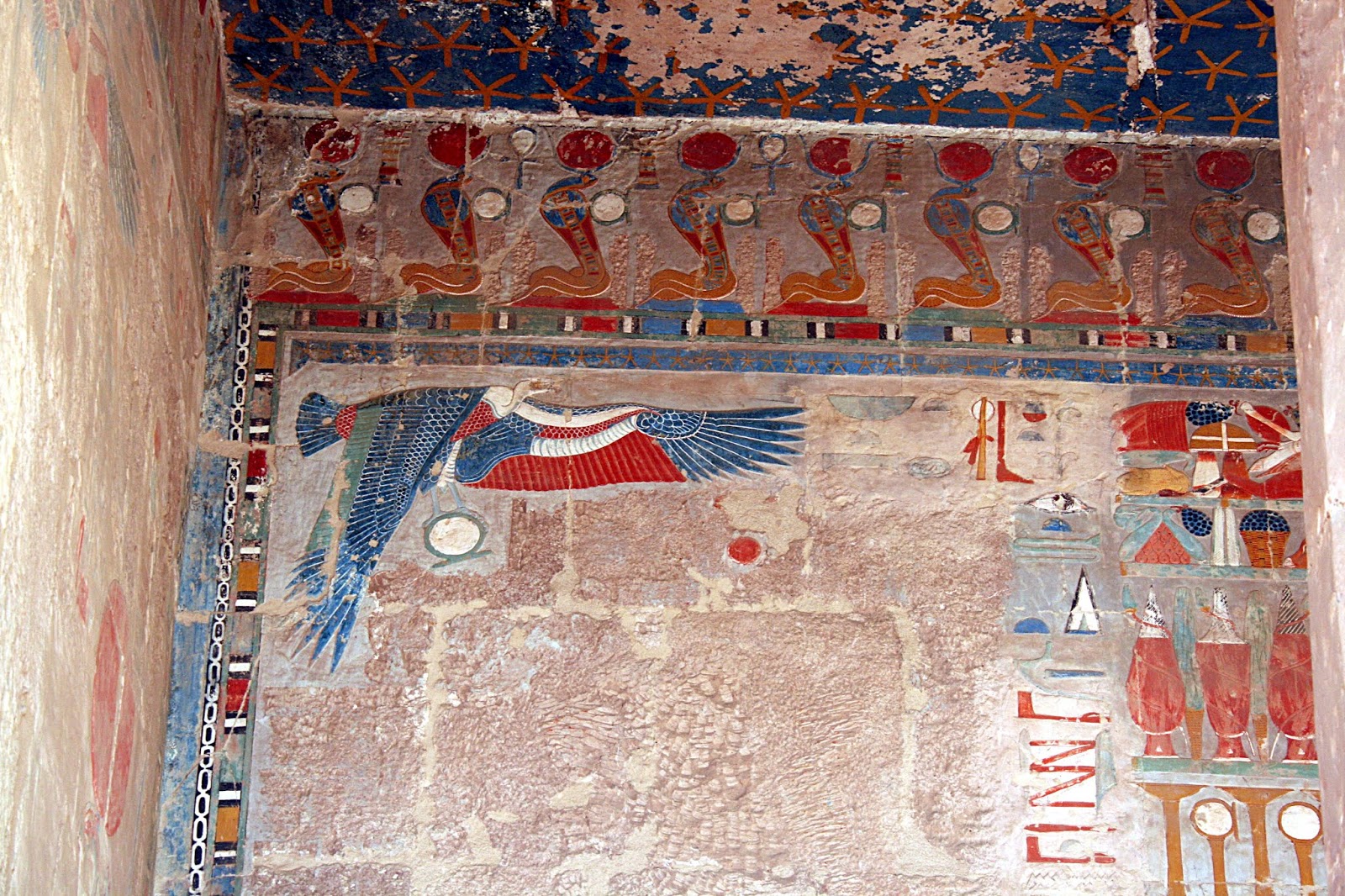
Hatshepsut Temple


Hatshepsut's chancellor, the royal architect Senenmut, oversaw the construction of the temple.
Although the adjacent, earlier mortuary temple of Mentuhotep II was used as a model, the two structures are nevertheless significantly different in many ways. Hatshepsut's temple employs a lengthy, colonnaded terrace that deviates from the centralised structure of Mentuhotep’s model – an anomaly that may be caused by the decentralized location of her burial chamber.


There are three layered terraces reaching 29.5 metres 
tall. Each story is articulated by a double colonnade of square piers, with the exception of the northwest corner of the central terrace, which employs proto-Doric columns to house the chapel. These terraces are connected by long ramps which were once surrounded by gardens with foreign plants including frankincense and myrrh trees.
The temple incorporates pylons, courts, hypostyle, sun court, chapel and sanctuary.


pharaoh


The word pharaoh ultimately derive from the Egyptian compound pr-ˤ "great house," written with the two biliteral hieroglyphs pr "house" and ˤ "column", here meaning "great" or "high". It was used only in larger phrases such as smr pr-ˤ "Courtier of the High House", with specific reference to the buildings of the court or palace.

 From the twelfth dynasty onward, the word appears in a wish formula "Great House, may it live, prosper, and be in health", but again only with reference to the royal palace and not the person.

During the reign of Thutmose III (circa 1479–1425 BCE) in the New Kingdom, after the foreign rule of the Hyksos during the Second Intermediate Period, pharaoh became the form of address for a person who was king.

The earliest instance where pr-ˤ3 is used specifically to address the ruler is in a letter to Amenhotep IV (Akhenaten), who reigned circa 1353–1336 BCE, which is addressed to "Pharaoh, all life, prosperity, and health".

 During the eighteenth dynasty (16th to 14th centuries BCE) the title pharaoh was employed as a reverential designation of the ruler. About the late twenty-first dynasty (10th century BCE), however, instead of being used alone as before, it began to be added to the other titles before the ruler's name, and from the twenty-fifth dynasty (eighth to seventh centuries BCE) it was, at least in ordinary usage, the only epithet prefixed to the royal appellative.

From the nineteenth dynasty onward pr-ˤ3 on its own was used as regularly as hm.f, "Majesty". The term, therefore, evolved from a word specifically referring to a building to a respectful designation for the ruler, particularly by the twenty-second dynasty and twenty-third dynasty.[citation needed]

For instance, the first dated appearance of the title pharaoh being attached to a ruler's name occurs in Year 17 of Siamun on a fragment from the Karnak Priestly Annals. Here, an induction of an individual to the Amun priesthood is dated specifically to the reign of Pharaoh Siamun.
 This new practice was continued under his successor Psusennes II and the twenty-second dynasty kings. For instance, the Large Dakhla stela is specifically dated to Year 5 of king "Pharaoh Shoshenk, beloved of Amun", whom all Egyptologists concur was Shoshenq I—the founder of the Twenty-second dynasty—including Alan Gardiner in his original 1933 publication of this stela.
 Shoshenq I was the second successor of Siamun. Meanwhile, the old custom of referring to the sovereign simply as pr-ˤ3 continued in traditional Egyptian narratives.

By this time, the Late Egyptian word is reconstructed to have been pronounced *[par-ʕoʔ] whence Herodotus derived the name of one of the Egyptian kings, Φερων.[10] In the Bible, the title also occurs as פרעה [par‘ōh]("Pharaoh").

 from that, Septuagint φαραώ pharaō and then Late Latin pharaō, both -n stem nouns. The Qur'an likewise spells it  fir'awn with "n" (here, always referring to the one evil king in the Exodus story, by contrast to the good king Aziz in sura 12's Joseph story). Interestingly, the Arabic combines the original pharyngeal ayin sound from Egyptian, along with the -n ending from Greek.

English at first spelt it "Pharao", but the King James Bible revived "Pharaoh" with "h" from the Hebrew. Meanwhile in Egypt itself, *[par-ʕoʔ] evolved into Sahidic Coptic ⲡⲣ̅ⲣⲟ prro and then rro (by mistaking p- as the definite article prefix "the" from ancient Egyptian p3).

Middle Kingdom

Middle Kingdom of Egypt

Amenemhat III, the last great ruler of the Middle Kingdom

The pharaohs of the Middle Kingdom restored the country's prosperity and stability, thereby stimulating a resurgence of art, literature, and monumental building projects.

 Mentuhotep II and his Eleventh Dynasty successors ruled from Thebes, but the vizier Amenemhat I, upon assuming kingship at the beginning of the Twelfth Dynasty around 1985 BC, shifted the nation's capital to the city of Itjtawy, located in Faiyum.

 From Itjtawy, the pharaohs of the Twelfth Dynasty undertook a far-sighted land reclamation and irrigation scheme to increase agricultural output in the region. 

Moreover, the military reconquered territory in Nubia that was rich in quarries and gold mines, while laborers built a defensive structure in the Eastern Delta, called the "Walls-of-the-Ruler", to defend against foreign attack.

With the pharaohs' having secured military and political security and vast agricultural and mineral wealth, the nation's population, arts, and religion flourished. In contrast to elitist Old Kingdom attitudes towards the gods, the Middle Kingdom experienced an increase in expressions of personal piety and what could be called a democratization of the afterlife, in which all people 

possessed a soul and could be welcomed into the company of the gods after death. Middle Kingdom literature featured sophisticated themes and characters written in a confident, eloquent style.[34] The relief and portrait sculpture of the period captured subtle, individual details that reached new heights of technical perfection.

The last great ruler of the Middle Kingdom, Amenemhat III, allowed Semitic-speaking Canaanite settlers from the Near East into the delta region to provide a sufficient labour force for his especially active mining and building campaigns. These ambitious building and mining activities, however, combined with severe Nile floods later in his reign, strained the economy and precipitated the slow decline into the Second Intermediate 


Period during the later Thirteenth and Fourteenth dynasties. During this decline, the Canaanite settlers began to seize control of the delta region, eventually coming to power in Egypt as the Hyksos.